Every YES costs you something.
ISSUE #004
Get A Little Unscattered in your inbox. Subscribe→
A new partnership comes up. Someone wants to start a new program. There’s an event we could host, a process we could improve, a tool we could finally implement, a project we’ve talked about for six months.
And somehow, every single one makes a perfectly reasonable case for yes.
That is usually where things get messy.
The part we forget to count
Every yes spends something. Time, attention, money, energy, or capacity from somebody who already has a job.
Because those costs do not always show up immediately, it is surprisingly easy to agree to something new without noticing what just got pushed aside. You say yes to the new initiative, but what work slows down? What meeting gets added? What existing priority quietly becomes less important even though nobody officially said so?
That is the part I think we underestimate.
We tend to evaluate opportunities one at a time, which makes almost everything look reasonable. A new partnership sounds good. A new program sounds good. A process improvement probably does too.
The problem is that they are all competing for the same limited pool of time, attention, money, and energy.
Good ideas can still compete
This is especially true in mission-driven organizations because the work matters. The people matter. The requests often come from a good place.
So saying no can feel weirdly personal.
Nobody wants to be the person saying, “We cannot do that right now.” Or, “We do not have the capacity.” Or even, “That idea is good, but it is not ours.”
But when everything stays on the table, the team still pays for the decision. People stretch. Existing work gets thinner. Important things get delayed, and everyone starts working a little harder while wondering why nothing feels finished.
Sometimes you simply have too many yeses stacked on top of one another.
Put all the options in the same room
One thing that has helped me tremendously is seeing competing work together.
Not one request on Monday, another idea on Wednesday, and a shiny new opportunity two weeks later. All of it, in one place.
Because when you evaluate each thing separately, almost everything can sound reasonable. It is much harder to pretend everything is equally important when you have to look at all of it on the same page.
Try this. Write down:
current priorities
active projects
new ideas
requests you are considering
things you keep saying you will “get to”
anything else using meaningful time or attention
If it is taking up room in someone’s head, put it down.
Then ask:
If we could only move three of these meaningfully in the next 90 days, which three would matter most?
Not which three are easiest. Not which three have the loudest advocate. Not which three feel newest.
Which three actually matter most?
That is where the tradeoffs start becoming visible.
“Not now” does a lot of work
I used to think saying no meant closing the door. A lot of the time, it really means not now.
That distinction helps because you are not declaring the idea bad. You are protecting the things you already decided were important.
And if priorities change later, great. Revisit it then.
But keeping every worthwhile possibility active at the same time is not flexibility.
It is expensive.
A simple yes filter
Before adding something new, I would ask four questions:
What current priority does this support?
If you cannot name one, that matters.What will get less attention if we say yes?
Something usually will. Name it.Who actually has the capacity to carry this?
Not theoretically. Actually.Would we still choose this if it meant delaying something already underway?
That question has a funny way of clarifying things.
Sometimes the new idea is worth the trade. Sometimes it is absolutely the right move.
But at least now you are choosing the tradeoff on purpose.
Your calendar is already voting
Even when you avoid making the tradeoff explicitly, your time still makes it for you.
Something gets less attention. Something slips. Something becomes rushed. Something stays half-done.
Capacity does not expand because the work is meaningful.
So when another good idea shows up, I would not ask only:
Should we do this?
Ask:
What are we willing to give less to if we do?
That answer tells you a lot.
Cheers to getting unscattered,

Put this into practice.
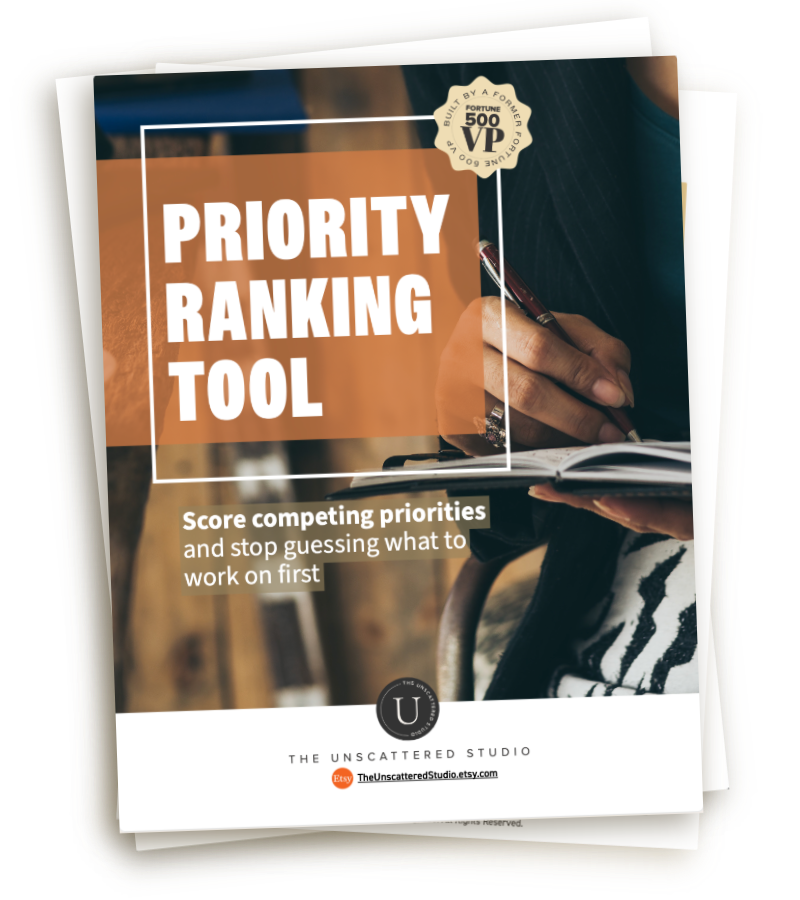
Use the Priority Ranking Tool to sort what matters, what can wait, and what needs a no.
Get A Little Unscattered in your inbox.
A little clarity for the work behind the work.