Your purpose statement might be useless.
ISSUE #001
Get A Little Unscattered in your inbox. Subscribe→
Years ago, I was asked to lead a brand-new team at a Fortune 500 company.
We had tight deadlines, high visibility, and no real playbook. So I wanted to do something simple before we got too far into the work: get clear on why we were doing it together.
I wanted one sentence we could come back to when priorities started competing, new ideas showed up, or people had different opinions about what mattered most.
My boss was not convinced.
“Purpose statements are a waste of time. No one ever uses them.”
I may have given him some sass at the time. I was very sure he was wrong.
And I still think he was wrong.
But I understand his point a lot better now.
A lot of purpose statements are pretty useless.
They sound nice. They get approved. They make their way onto a slide or website. Maybe someone reads them at an annual meeting.
Then everyone goes right back to making decisions the same way they did before.
That is where the whole thing falls apart.
A purpose statement is only useful if it actually helps you decide something.
What is your purpose helping you decide?
This is where purpose starts earning its keep. A new idea comes in. Someone wants to launch another program. A partnership opportunity shows up. The team is split on what deserves attention first.
Now you have something to test the decision against.
A useful purpose should help you ask:
Does this belong here?
Does this move the work we exist to do?
Is this worth the capacity it will take?
Is this ours to do right now?
What are we saying yes to?
What are we willing to say no to?
That is a very different job than simply giving people an inspiring sentence.
Why this matters when everything feels important
Mission-driven organizations are full of good ideas.
Good people.
Good causes.
Good opportunities.
And that is exactly why things can get messy. When almost everything feels worthwhile, it becomes very easy to keep adding.
✔️ Another program.
✔️ Another event.
✔️ Another partnership.
✔️ Another initiative.
✔️ Another “quick thing.”
Before long, the organization has more good work than the people inside it can realistically carry.
A clear purpose gives you an anchor. It does not magically make the decision easy. But it gives you a better place to start.
Three ways a useful purpose actually helps
1. It helps you filter priorities
Not every worthwhile thing belongs on your list right now. A clear purpose gives you something stronger than preference when two good options are competing for the same time, money, or attention.
You can ask which one gets closer to the work you are actually here to do.
That sounds simple. It is.
And simple is useful.
2. It helps people make better decisions without waiting for you
This matters more as an organization grows. If the only way to know what belongs is to ask the leader, every small decision eventually travels back uphill. That gets old very quickly.
A clear purpose gives people a shared reference point. They can make better calls because they have a clearer sense of what fits and what does not.
That is good for the team.
It is also good for the person who is tired of answering every question.
3. It gives you permission to say no
This may be the biggest one. Sometimes the hardest decisions are not between a good idea and a bad one. They are between two good ideas when you only have room for one.
A clear purpose helps you separate:
good
useful
important
ours
Those are not always the same thing. And when we skip that distinction, “yes” becomes the default. That is usually where capacity starts getting quietly eaten alive.
The sentence itself is not the strategy
Looking back, I still believe that team needed a clear purpose. But I think my boss had probably seen enough purpose statements that sounded important and changed absolutely nothing.
I have too.
The words themselves are not the valuable part. The value shows up when the purpose helps your team make a call. So if your organization already has a purpose statement, I would not start by rewriting it.
Start here:
What decisions should this help us make?
Then look at the actual work in front of you.
What should get more attention?
What can wait?
What should stop?
What does not really belong anymore?
Where are we saying yes because something is good, even though it is not actually ours?
If your purpose cannot help you answer any of those questions, it may need more work. Or it may just need to start doing the job it was supposed to do in the first place.
Cheers to getting unscattered,

Put this into practice.
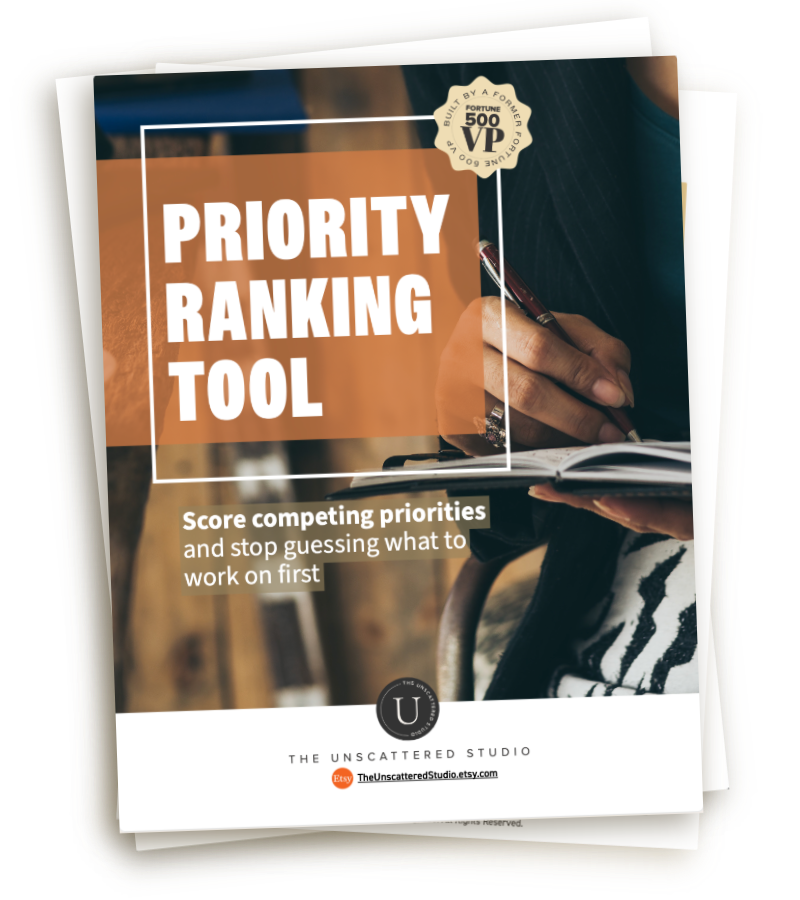
Use the Priority Ranking Tool to sort what matters, what can wait, and what needs a no.
Get A Little Unscattered in your inbox.
A little clarity for the work behind the work.