Stop making every decision twice.
ISSUE #002
Get A Little Unscattered in your inbox. Subscribe→
In my corporate VP days, I made decisions fast.
Budgets. Staffing. Which initiatives deserved resources. What needed attention now and what could wait. I could look at the information, use the guardrails around me, trust my judgment, and make the call.
Then I left corporate life and started working for myself.
Suddenly, I could spend an embarrassing amount of time deciding whether to buy a $29 piece of software.
Should I invest in this?
Should I launch that?
Should I pursue this opportunity now or later?
I would think about something all day, sleep on it, revisit it the next morning... and somehow still be reconsidering the exact same decision two days later.
That was new.
The decisions were not necessarily harder
What had disappeared were the guardrails. Inside a large organization, decisions rarely happen in complete isolation. There are budgets, annual goals, approval levels, strategic plans, team capacity, quarterly priorities.
You may not love all of them, but they give you something to decide against.
When I left, a lot of that disappeared.
No leadership meeting was going to force a call. No quarterly target was automatically going to eliminate an option. No one was waiting for my final sign-off except me.
That freedom felt incredible.
It also created a ridiculous number of open loops. And I started noticing something else.
Sometimes I was not actually working through a decision.
I was avoiding it.
I could research another option. Rearrange a plan. Make another list. Do something useful-looking while the one decision that actually mattered sat there waiting for me.
Cold outreach, anyone? 😫
The longer I waited, the heavier the decision became.
I needed a filter
Eventually I realized I did not need to become more confident before making decisions. I needed fewer decisions to require a full internal trial.
So I started asking the same questions again and again. They became my decision filter.
1. Does this support what matters most right now?
This eliminates more options than you might expect.
A good idea can still be the wrong idea right now.
That distinction matters because mission-driven teams tend to have an endless supply of worthwhile things they could do.
Another event.
Another program.
Another partnership.
Another improvement.
Another request from someone we care about.
Without a clear priority, they all start competing as if they deserve equal attention.
They do not.
When I am considering something new, I want to know whether it supports the work we have already said matters most.
If it does not, I do not automatically reject it.
But it loses its ability to masquerade as urgent.
2. Does this fit the capacity we actually have?
This one has humbled me more than once.
I can build a beautiful plan around an imaginary version of my life where I apparently have unlimited time, energy, and attention.
Real Kris is less accommodating.
Organizations do this too.
A decision can make perfect strategic sense on paper and still be a terrible decision for the humans expected to carry it.
Before saying yes, look at what is already true:
Who will own this?
What will it require from them?
What will move slower because of it?
What will stop?
Are we quietly assuming capacity that does not exist?
Sometimes the question is not, “Can we do this?”
It is:
Can we do this without making everything else worse?
Very different answer.
3. Does this move the current priority forward?
I like shorter planning horizons for this reason.
You do not need every decision to perfectly support some ten-year master plan.
You do need enough clarity to know what matters in this season.
A 90-day priority, quarterly goal, or current organizational focus gives you a much better filter than:
Is this a good idea?
Lots of things are good ideas.
The more useful question is:
Does this help us move what we already decided matters?
That gives you permission to say:
not now
maybe later
this belongs next quarter
good idea, wrong season
Those are decisions too.
4. Are we choosing this because it belongs... or because we feel like we should?
“Should” can create an impressive amount of unnecessary work.
→ We should be on that platform.
→ We should hold that event.
→ We should offer this program.
→ We should do what that other organization is doing.
Sometimes there is a legitimate reason behind the should. Sometimes it is just comparison, habit, guilt, or somebody else’s definition of what a serious organization is supposed to look like.
Those are worth separating.
I have made decisions because they looked strategically correct and later realized I had never stopped to ask whether they fit what I was actually trying to build.
That is a noisy way to operate.
5. Will this make the work clearer or heavier?
This may be my favorite question. Because almost every yes creates something downstream.
→ Another system to maintain.
→ Another meeting.
→ Another process.
→ Another owner.
→ Another decision somebody has to remember later.
That does not automatically make the answer no. Some things are absolutely worth the additional complexity. But the complexity should be part of the decision.
If an idea creates more moving parts, I want to know what I am getting in return. Otherwise, you can accidentally build an organization that spends most of its energy maintaining the things it once decided to start.
The three-minute version
I do not pull out a five-part worksheet every time I need to make a small call.
For the everyday decisions that start looping, I use a faster version.
I give myself about three minutes and ask:
Does this support the current priority?
Do we actually have what we need to move forward?
Does this need to be decided now?
If the answers are clear enough, I make the call. If they are not, I deliberately park it. That last part matters.
“Not deciding yet” can be a decision.
The problem is when we leave something mentally open while continuing to reconsider it every six hours.
A decision should eventually become a decision
I still revisit choices when new information shows up. That is different from reopening them because I am uncomfortable with having chosen. There is a point where more thinking stops improving the decision.
It just keeps the decision alive.
So if you keep circling the same choice, I would not start by asking whether you need more confidence. Ask whether you have a filter.
What matters right now?
What can your people actually carry?
What does this choice move forward?
And if the answer is clear enough... make the call. Then let yourself move on.
Cheers to getting unscattered,

Put this into practice.
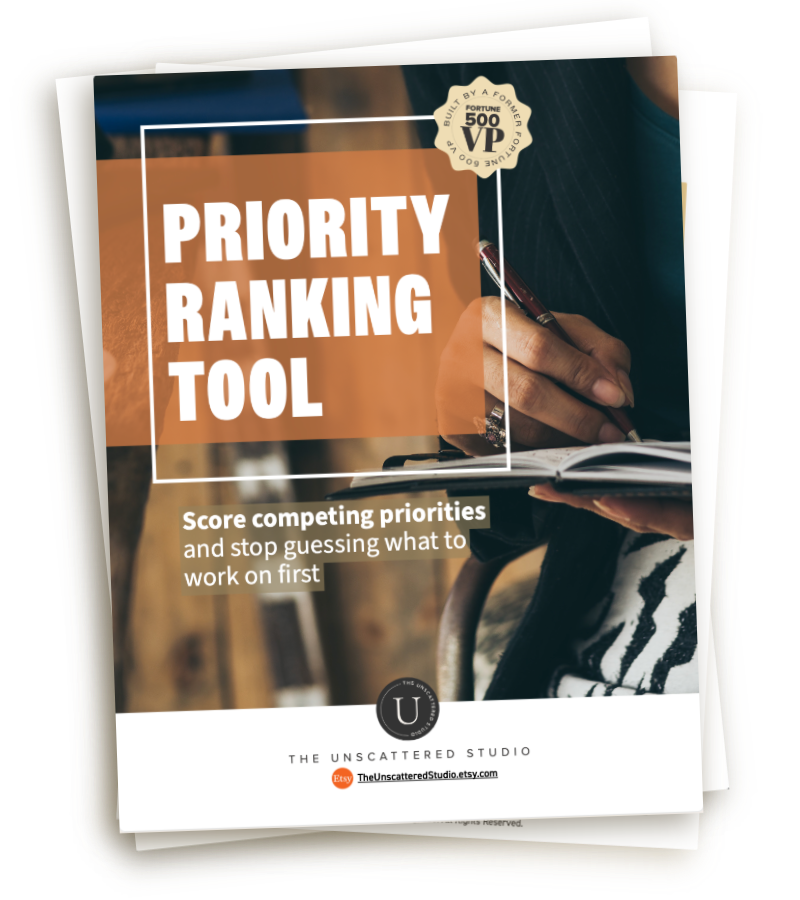
When several priorities are competing and everything feels important, use the Priority Ranking Tool to score the options and see what actually deserves attention first.
Get A Little Unscattered in your inbox.
A little clarity for the work behind the work.